
Cannabis Post-Harvest Control: Why Drying and Curing Matter as Much as the Grow
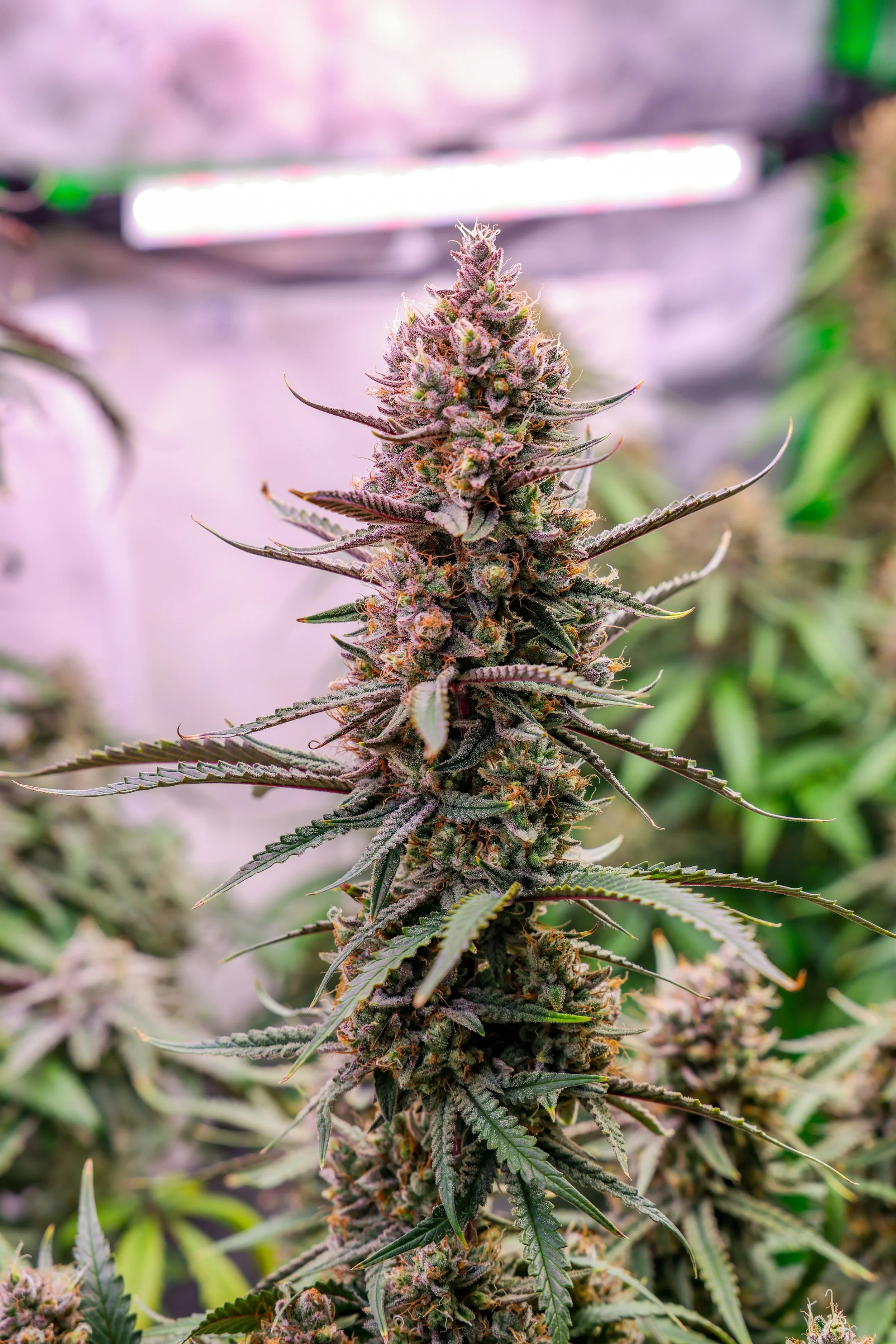
California Sour Diesel Autoflower by Humboldt Seed Company reaches peak maturity, ready to begin the critical drying and curing process. Photo: Ginja.Club
A cannabis plant can look beautiful at harvest and still lose quality in the final stage. Drying and curing are not cleanup steps after the real work is done. They are part of the grow. In many cases, they determine whether the finished flower is smooth, aromatic, stable, and enjoyable, or harsh, flat, brittle, grassy, or inconsistent.
Commercial growers understand this well because post-harvest handling directly affects shelf life, aroma, market value, and customer experience. Home growers often understand the importance, too, but they are working with more limited space. A tent grower may have everything dialed in during cultivation, only to end up drying in a bathroom, attic, basement, spare room, or closet because the next grow is already waiting.
Sometimes that works. Often it does not.
The principle behind good post-harvest handling is simple: low and slow. The science behind it is a little more interesting.
Drying Is Moisture Movement, Not Just Evaporation
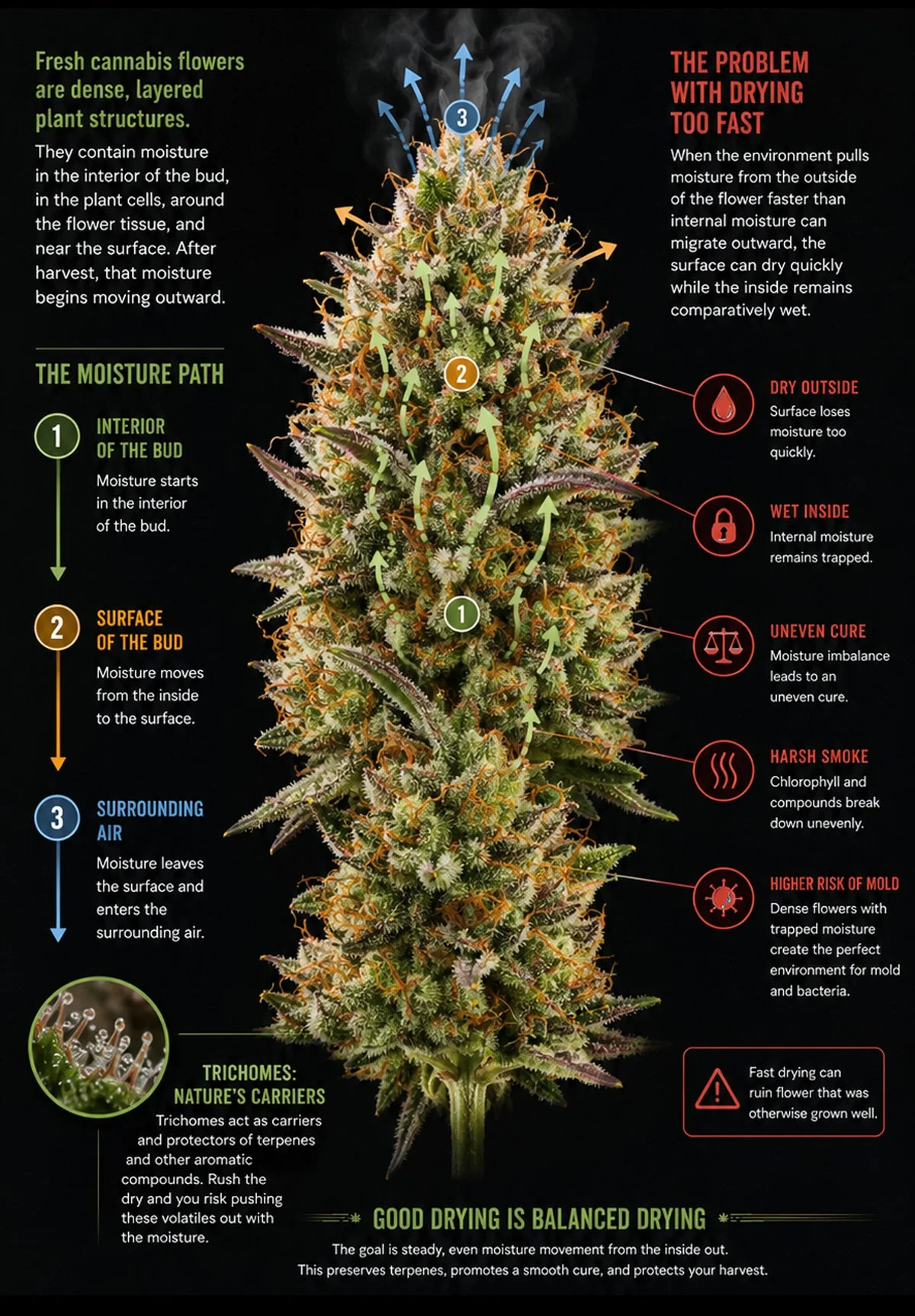
Fresh cannabis flowers are dense, layered plant structures. They contain moisture in the interior of the bud, in the plant cells, around the flower tissue, and near the surface. After harvest, that moisture begins moving outward.
The basic path looks like this:
Interior of the bud → surface of the bud → surrounding air
The problem begins when the environment pulls moisture from the outside of the flower faster than internal moisture can migrate outward. If the room is too warm, too dry, or has aggressive airflow, the surface can dry quickly while the inside remains comparatively wet.
That imbalance causes several problems.
The flower may feel dry on the outside, but still holds too much internal moisture. The cure may become uneven. The smoke may be harsh. Dense flowers may pose a higher risk of mold if internal moisture remains elevated for too long. This is why fast drying can ruin flower that was otherwise grown well.
Good drying is not about forcing water out as quickly as possible. It is about allowing moisture to leave gradually and evenly.
Case Hardening: The Dry Outside, Wet Inside Problem
One of the most common drying mistakes is drying the outside of the flower too quickly. When that happens, the outer layer can become slightly hardened or sealed off. This is often called case hardening. Case hardening slows the movement of moisture from the center of the bud toward the outside. The flower may look and feel dry, but the inside has not stabilized. That can create uneven texture, a rough cure, and a higher risk of musty or sour notes developing later.
This is one reason the old “just hang it somewhere warm until it feels dry” approach is unreliable. Cannabis flowers are not thin leaves. Dense buds do not dry evenly unless the environment gives moisture time to migrate from the inside out. A low-and-slow dry helps prevent this. Lower temperatures and moderate humidity allow internal moisture to equalize gradually rather than creating a dry shell around a wet center.
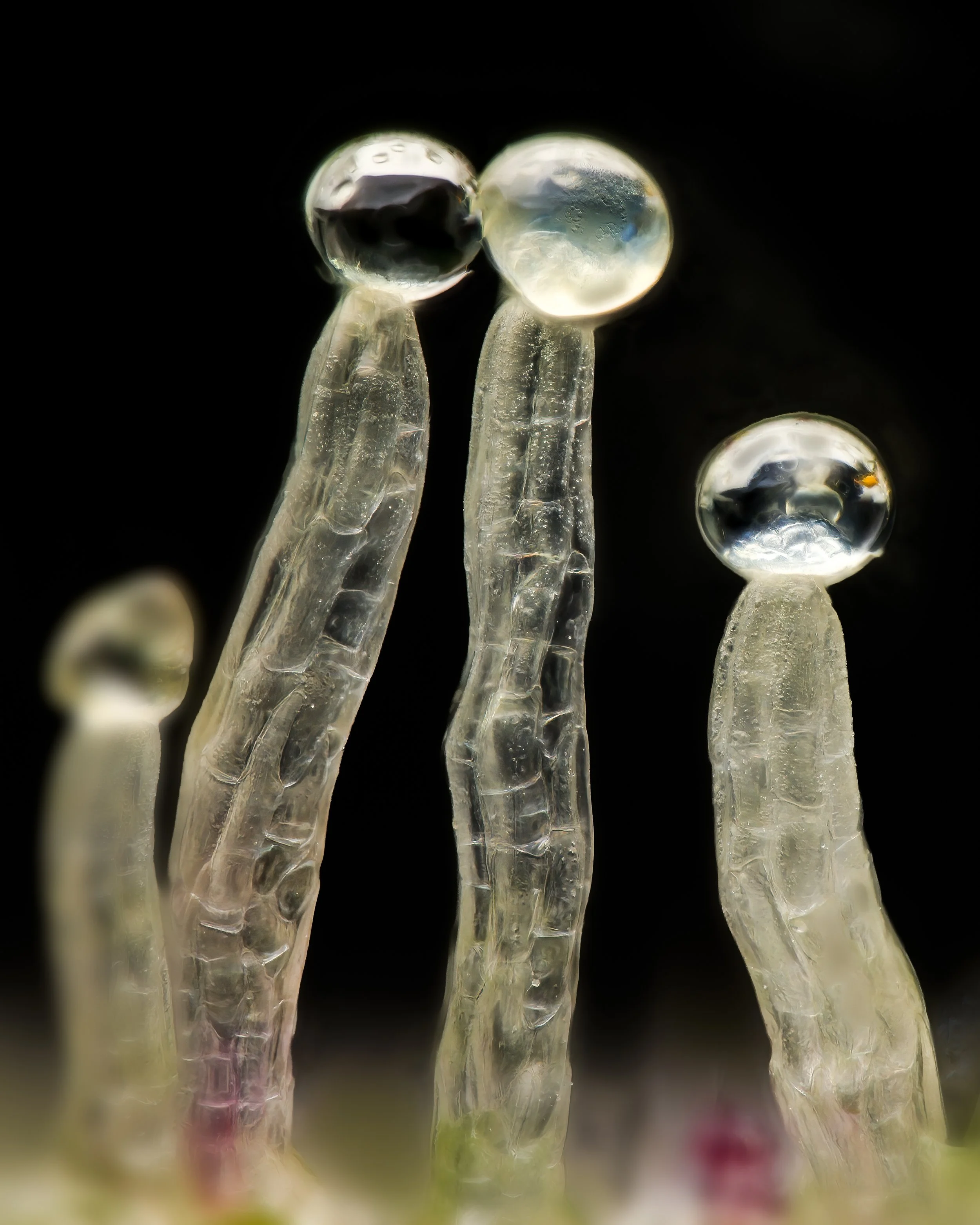
Glandular trichomes carry and protect many of the plant’s aromatic compounds, including terpenes. If drying temperatures run too high, those volatile terpenes can evaporate too quickly, diminishing aroma and character. Photo: Ginja.Club
Terpenes Are Volatile
Drying is also about preserving aroma. Terpenes are a major part of what gives cannabis its cultivar-specific smell and flavor. They are also volatile, meaning they evaporate easily, especially under warmer conditions or in strong airflow.
When flower is dried too warm or too fast, the most delicate aromatic compounds are often the first to go. That can leave the finished flower smelling dull, grassy, or one-dimensional, even if the plant was fragrant at harvest.
This is why many growers aim for modest drying temperatures, often around 60–65°F (16–18°C). Lower temperatures help slow terpene evaporation and preserve more of the flower’s aromatic complexity.
The goal is not just “dry weed.” The goal is dried flower that still carries the character of the plant.
What Curing Actually Does
Curing is often described as “waiting,” but that undersells what is happening. Curing is a controlled stabilization period after the initial dry.
During drying, the bulk of the free moisture leaves the flower. During curing, the remaining moisture redistributes more evenly throughout the plant material. This improves texture, burn quality, grind quality, and smoke smoothness.
Curing also helps reduce the harsh green character often found in rushed flower. That grassy bite is not caused by one single compound. It comes from chlorophyll-associated compounds, fresh-plant volatiles, and other plant metabolites that have not had time to settle or break down.
A good cure does not increase potency—it preserves and refines what is already there. It helps maintain aroma, texture, and stability while reducing avoidable losses due to heat, oxygen exposure, and humidity fluctuations.
Why 60/60 Became a Useful Reference Point
Many growers use 60°F (16°C) and 60% relative humidity as a practical reference for curing and longer stabilization. It is not magic, and it is not the only possible target, but it is a useful baseline.
At around 60°F (16°C)/60% RH, flower tends to remain supple without being wet. It is less likely to over-dry than lower-humidity storage, and it is less exposed to terpene loss than it would be under warmer conditions. It also helps reduce microbial risk compared to environments that are too humid.
In post-harvest handling, stability matters as much as the exact number. Repeated swings in temperature and humidity can stress the flower, change texture, and reduce aromatic quality.
The Home Grower Conundrum
The challenge for home growers is not usually a lack of knowledge—it is a lack of environmental control.
A normal house is not designed to dry cannabis. HVAC systems cycle on and off. Outdoor weather affects indoor humidity. Attics get hot. Bathrooms get damp. Closets have poor airflow. Spare rooms may be too warm during the day and too cool or humid at night.
The result is inconsistency. One harvest dries nicely. The next one dries too fast. Another one hangs too long in a damp room. The grower may have done everything right in the tent, but the post-harvest environment ultimately determines the final quality.
For growers, here are a couple of good solutions.
Option One: Use a Dedicated Post-Harvest System
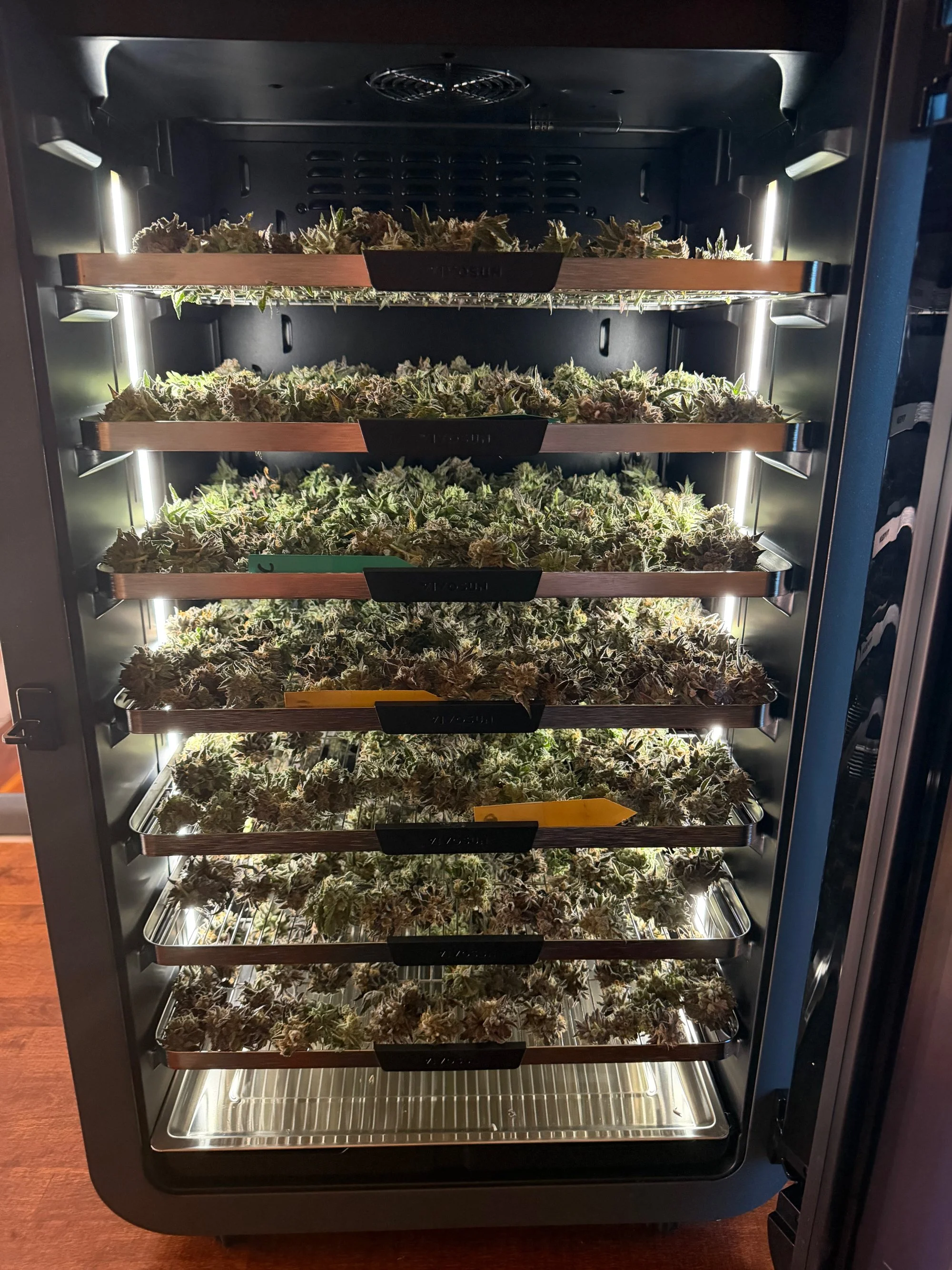
Freshly harvested cannabis flowers arranged across the drying trays inside the VIVOSUN VCure. Controlled temperature, humidity, and airflow help moisture leave the flowers gradually and evenly. Photo Christian Petke
The first option is a dedicated post-harvest machine.
This is where the VIVOSUN VCure Smart Post-Harvest Box becomes interesting. Instead of trying to turn a room or tent into a curing environment, VCure gives growers a dedicated chamber for drying, curing, and holding finished flower.
The unit controls both temperature and humidity, with a working range of 50–72°F (10–22°C) and 55–65% RH. It also includes app control, preset drying and curing profiles, and custom programs for growers who want to fine-tune their own post-harvest process.
Capacity is listed at 24 gallons, which makes it realistic for a serious home grower working with a 4x4 tent-sized harvest. In practical terms, it can handle roughly the harvest from a 4x4 tent, about 2 pounds of fresh-cut plant material, depending on flower density, trim style, and how the material is loaded.
Hands-On Test: Treating VCure Like a Real Tool
The useful question with any post-harvest device is not whether it sounds good on paper. The question is whether it produces better flower in a real home-grow setup.
We put the VCure through its paces with fresh material and treated it like a serious post-harvest tool rather than a gadget. The chamber was loaded, the program was adjusted, the process was monitored, and the result was evaluated like any other drying and curing method.
The built-in profiles are useful, especially for growers who want a guided starting point. But the ability to customize the process is important. The default drying temperature runs a little warmer than preferred for a slow craft-style dry, so the program was dialed down and extended.
That flexibility matters. Different cultivars behave differently. Dense flowers do not dry like airy flowers. Wet-trimmed material does not behave exactly like branch-hung material. A good post-harvest system should provide the grower with structure without locking them into a single rigid recipe.
VCure does that well.
Consistency Is the Main Advantage
The biggest advantage of the VCure solution was consistency.
In a normal home environment, the grower is often reacting to the room.
Is the room too warm? Did humidity spike overnight? Is the AC running too often? Is the flower drying too fast near the fan? Is the center of the bud still holding moisture?
With VCure, the environment is managed inside the chamber. The app controls the process, and once the program is running, there is very little to do.
In fact, the best approach is to leave the machine closed while it is working. Opening the chamber repeatedly disrupts the controlled environment and forces the machine to work harder to stabilize conditions. For best results, the flower should be loaded properly, the program should be set, and the unit should be allowed to do its job.
There is no need to add water during the process, and the machine is also very quiet. That may sound like a small detail, but for home growers it matters. Post-harvest equipment often runs in a living space, garage, spare room, or work area. A loud machine becomes annoying quickly. VCure stayed quiet enough to feel practical in a home setting.
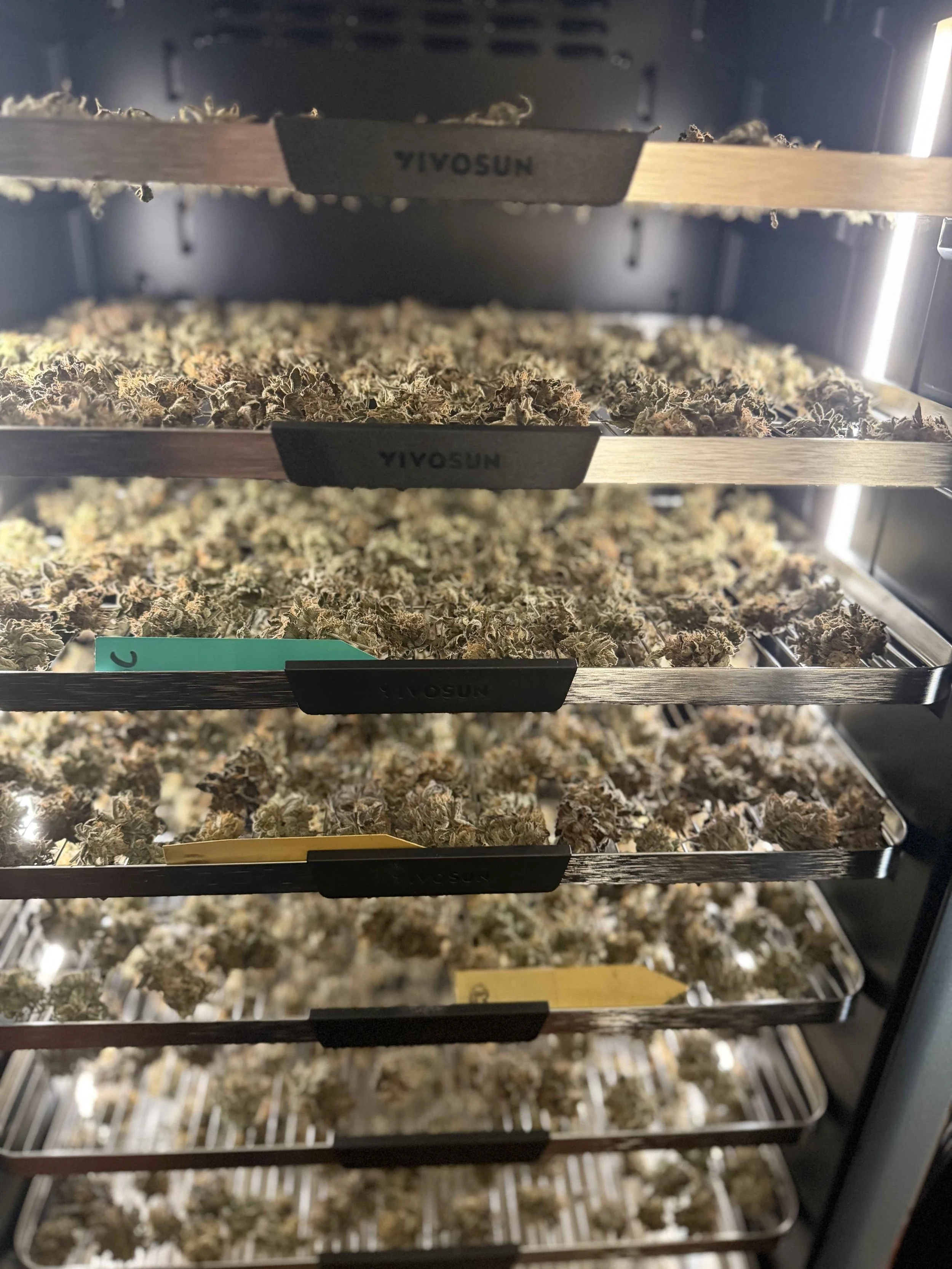
Cannabis flower midway through the controlled curing cycle inside the VIVOSUN VCure. The trays keep the harvest evenly distributed while the system manages temperature, humidity, and airflow. Photo Christian Petke
The Result
The finished flower came out smooth, fragrant, and evenly stabilized. The kind of controlled dry and cure that is often difficult to achieve in a normal home environment was much easier to repeat. No guessing whether the room was too warm. No chasing humidity swings. No improvised jar routine. No constant checking. Just a stable post-harvest environment managing the process.
The flower retained aroma, kept a good texture, and smoked smoothly. That is ultimately the point. A post-harvest tool only matters if it protects the quality of the harvest.
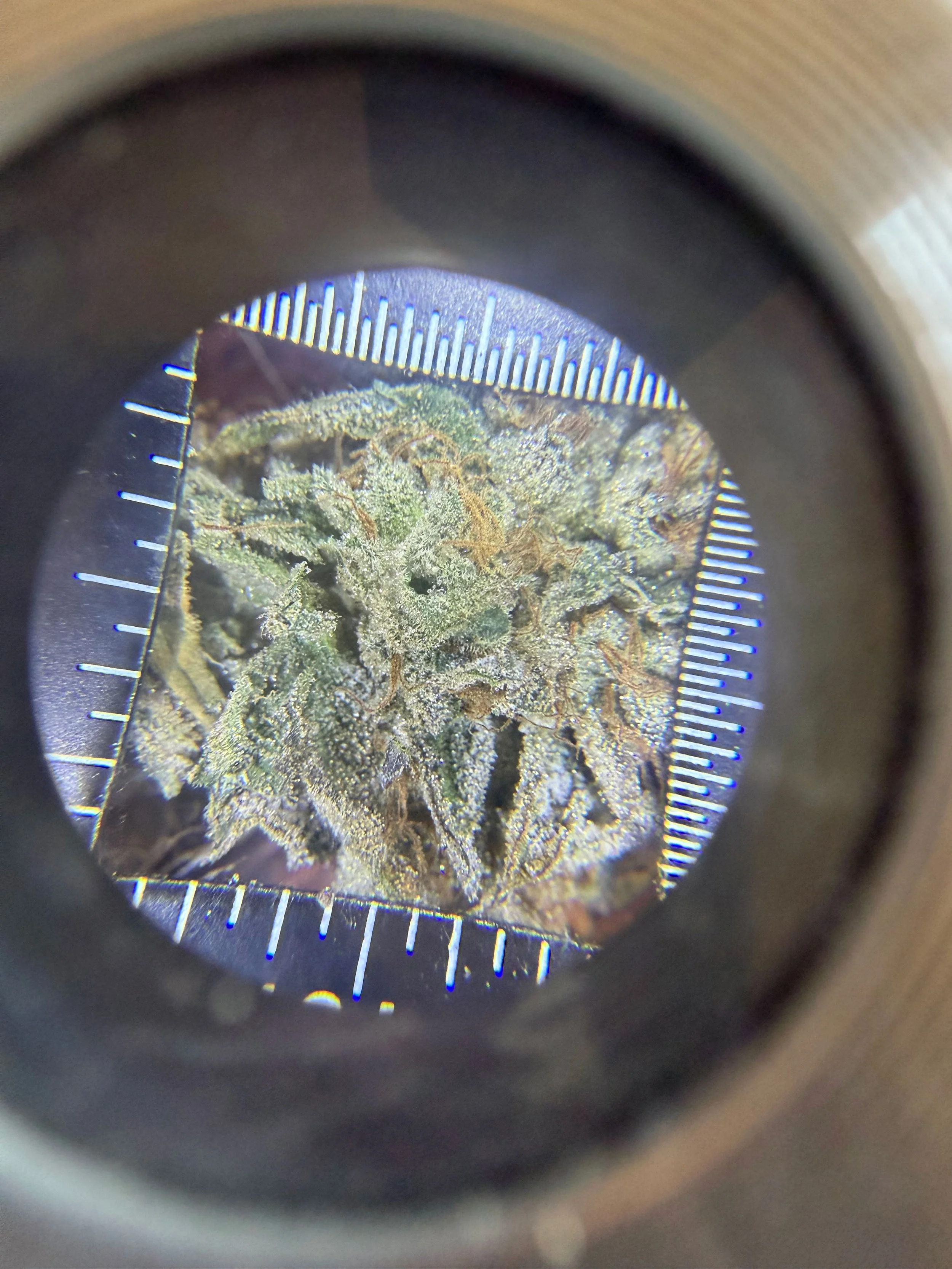
Dried and cured cannabis flower viewed under magnification. The glandular trichomes remain visibly intact across the surface, indicating that the flower was handled carefully throughout drying, curing, and storage. Preserving these delicate resin structures helps protect the plant’s aroma, flavor, and overall quality. Photo Christian Petke
The Holding Function: A Wine Fridge for Cannabis
One of the most useful features was the holding function.
Once cannabis is dried and cured, storage becomes the next challenge. Finished flower still responds to temperature, humidity, oxygen exposure, and time. Poor storage can dry it out, flatten the aroma, or reduce the quality that the grower worked so hard to preserve.
VCure can be used as a stable holding chamber after the dry and cure are complete. Think of it like a wine fridge for cannabis. It gives finished flower a controlled environment instead of leaving jars or bags at the mercy of the room.
In our test, the holding environment was set to 58°F (14°C) and 62% relative humidity. That kept the flower in excellent condition and helped preserve the smooth, aromatic smoke that came out of the cure.
For growers who harvest more than they consume immediately, that holding function is more than a bonus. It extends the machine's value beyond drying and curing.
Bottom line: VCure makes the post-harvest process easier, cleaner, and more repeatable. It’s a serious tool for home growers who want their harvest to finish as well as it grew.
Option Two: Use the Grow Tent as a Drying Room
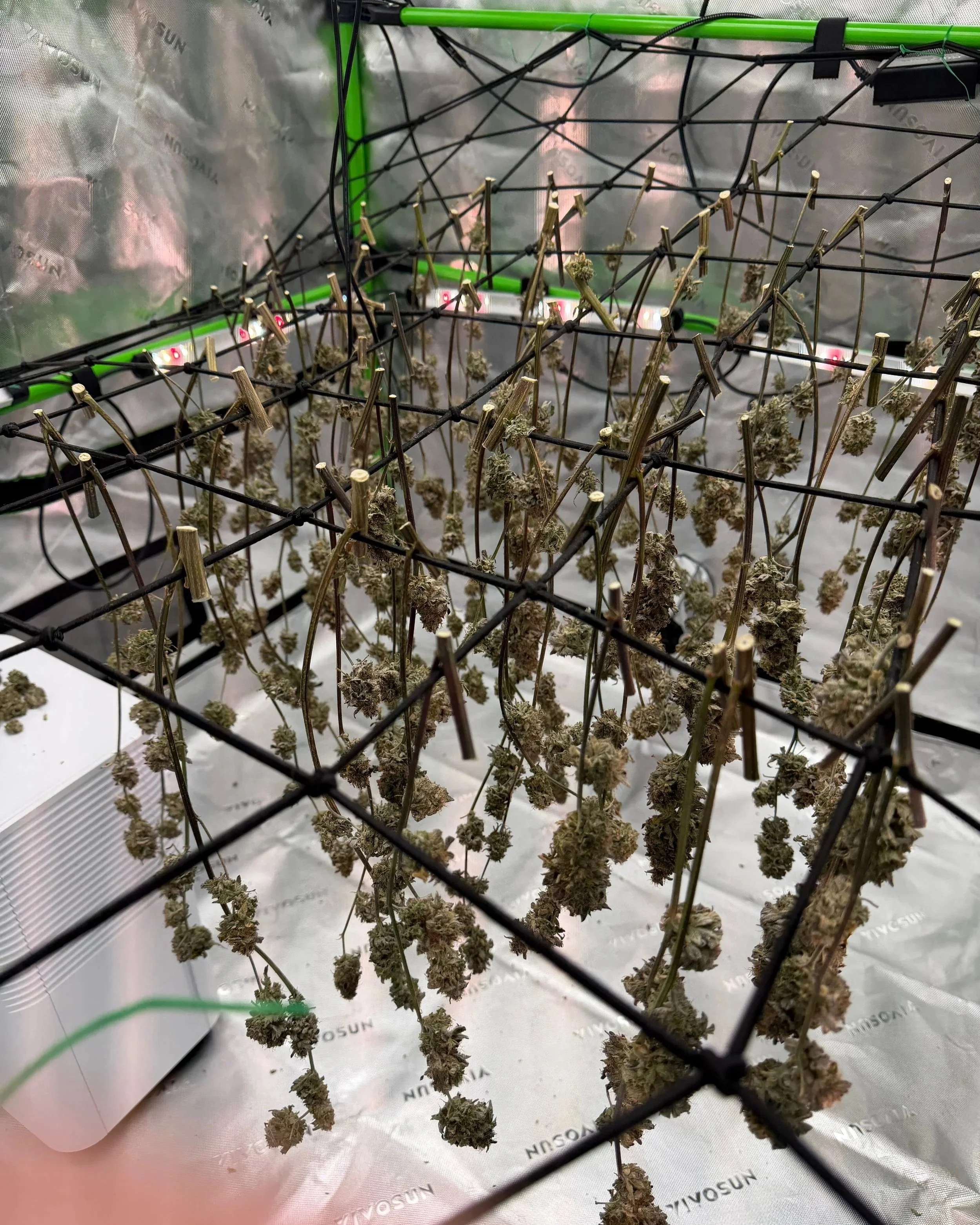
Drying cannabis in your grow tent offers several advantages: the space is already enclosed, ventilated, and equipped with basic climate control. Here, the existing trellis is repurposed to suspend harvested branches, keeping them evenly spaced for consistent airflow and drying. Photo Christian Petke
The second option is to use the grow tent itself. This can work very well because the tent is already a controlled space. It has airflow, ventilation, odor filtration, and a defined area for managing conditions. Many tent kits also include a trellis or support system for hanging branches or flowers.
To make the tent function properly as a drying room, temperature and humidity control remain important. In our experiment, we used a small dehumidifier and the VIVOSUN AeroLush C08 as an air conditioner to help control temperature. With those tools in place, the tent can become a much more reliable post-harvest environment.
A practical starting point is around 65°F (18°C) and about 50% relative humidity for the first stage of drying. After the first few days, humidity can approach 55% as the flower begins to stabilize. The goal is a gradual dry, not a race.
A simple physical cue is the small-stem snap test. When smaller stems snap rather than bend, the flower is usually ready to move into curing. It should not be brittle or dusty. There should still be some life and texture in the bud.
From there, a steady 60°F (16°C)/60% RH cure is a reliable reference point for smoothness, aroma, and long-term stability.
The downside of using the tent is timing. The grow space is tied up while the harvest dries. For some growers, that is fine. For others, especially those trying to keep a perpetual cycle going, the tent becomes valuable real estate.
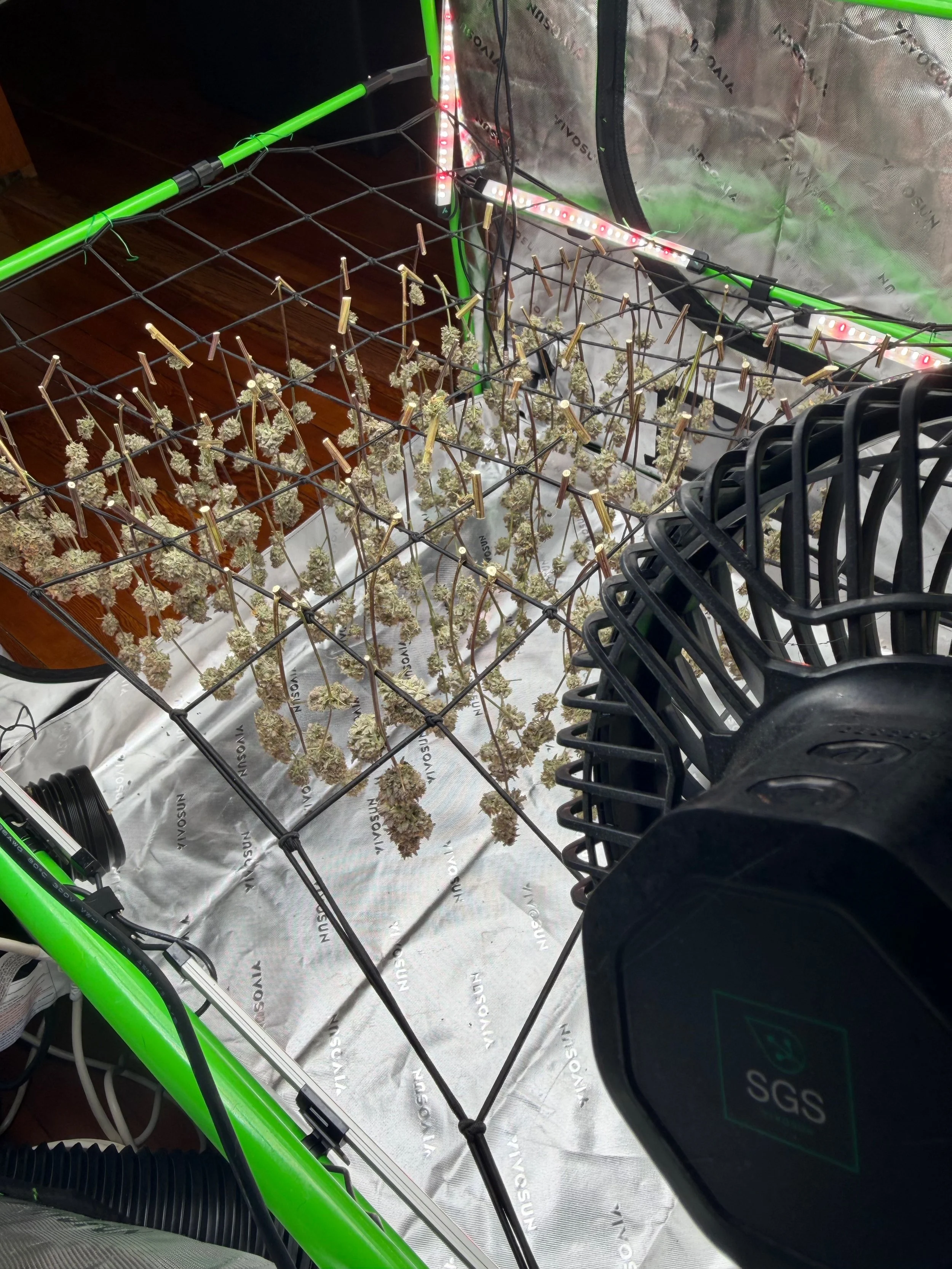
The built-in circulation fan keeps air moving gently around the hanging branches, helping moisture escape evenly while reducing stagnant pockets that can encourage mold. Photo Christian Petke
Post-Harvest Control: Key Takeaways
The larger lesson is not that every grower must use a machine. The lesson is that post-harvest control matters.
Whether flower is dried in a tent or in a dedicated chamber like VCure, the goals are the same:
• Protect the terpenes.
• Let moisture move gradually from the inside out.
• Avoid heat spikes.
• Avoid drying the outside too fast.
• Prevent humidity swings.
• Give the flower enough time to stabilize.
Good post-harvest handling does not rescue poorly grown cannabis, but poor post-harvest handling can absolutely damage well-grown cannabis. Drying and curing are where the plant becomes finished flower.